Rana platform overview
Working with Rana: Online and Offline
Rana is built around one central idea: water analysis is more than a single calculation. It brings data, schematisations, models, results and decisions together within one coherent project environment, ensuring everything stays traceable, reusable and understandable in its full context.
To support this end‑to‑end workflow, Rana offers two complementary environments:
a cloud‑based Rana Web Platform and
a powerful Rana Desktop Client.
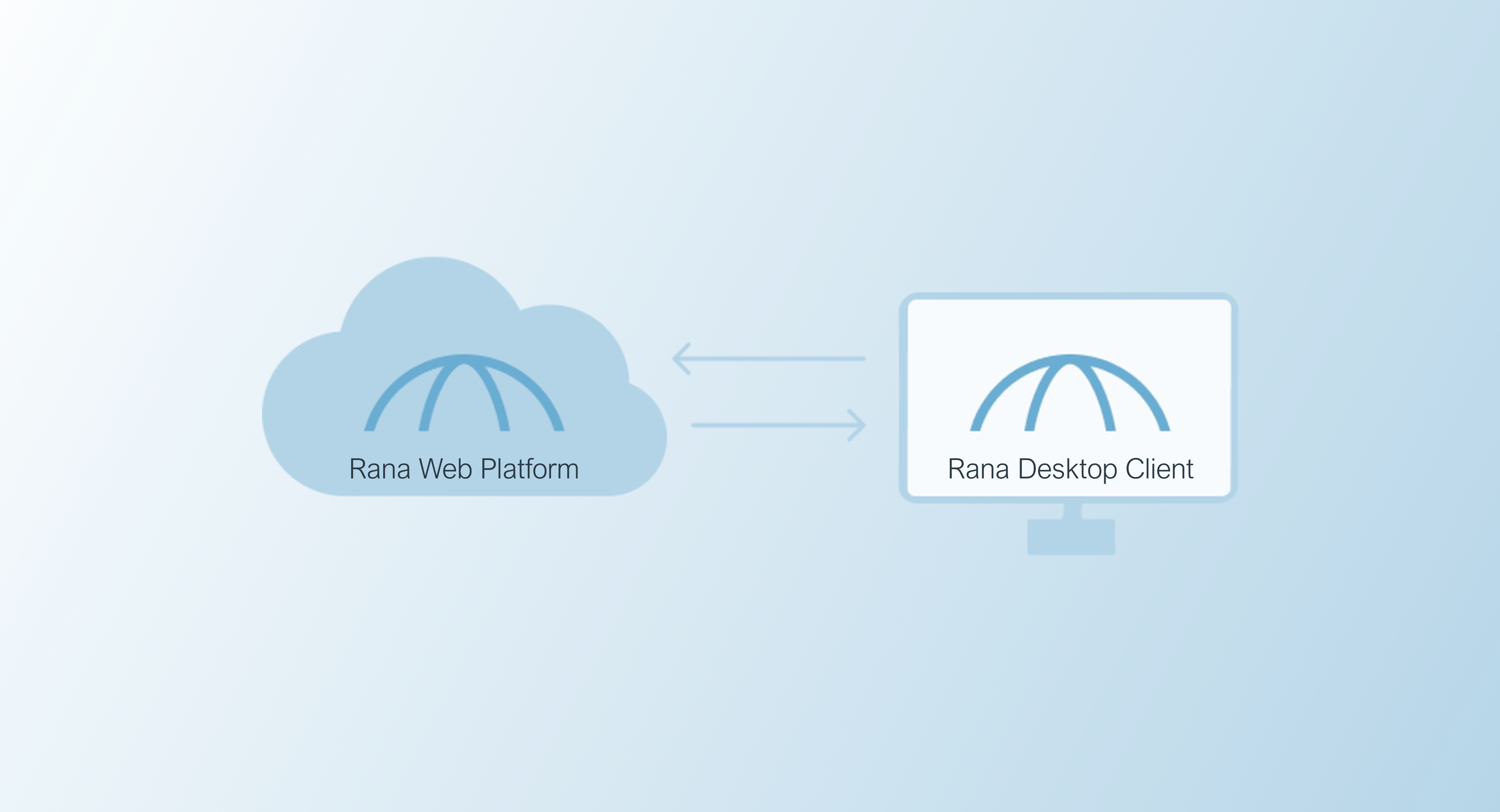
Rana Web Platform (Online)
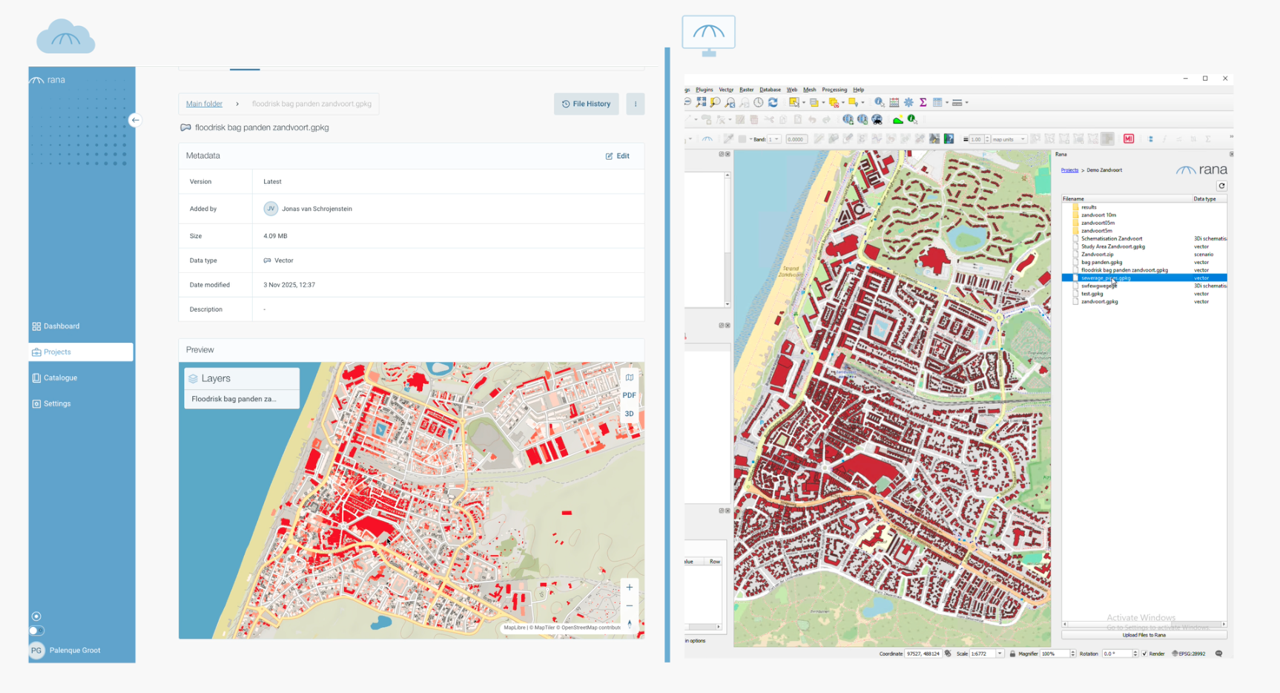
The web platform is the primary environment for exploring water analyses, viewing project information, collaborating, and working with spatial data. It allows users to upload, view and share GIS files effortlessly, even with non‑GIS specialists, ensuring a shared understanding across all stakeholders.
It is the go‑to place for accessing models, results and insights in context, and enables smooth collaboration within project teams.
Rana Desktop Client (Offline)
The desktop client is tailored for technical specialists and modellers who need local computing power or an offline setup. While Rana supports model analyses online, modellers who work with complex hydrodynamic simulations or large datasets may prefer the desktop environment for specialised workflows. Rana’s modelling ecosystem has long been familiar territory for expert hydrodynamic modellers and provides full support for advanced simulation work.
An overview of Rana
Projects form the foundation of Rana. They are the central organizational layer that brings together all components of a water analysis, data, schematisations, models, results and decisions, into one coherent context.
Everything you do in Rana takes place within a project. Projects can range from personal workspaces for your own analyses to fully collaborative environments shared with colleagues, partners or external specialists.
Within each project, dedicated domains provide all the tools and functionality needed to manage, explore and perform water analyses that remain easy to interpret and reuse.
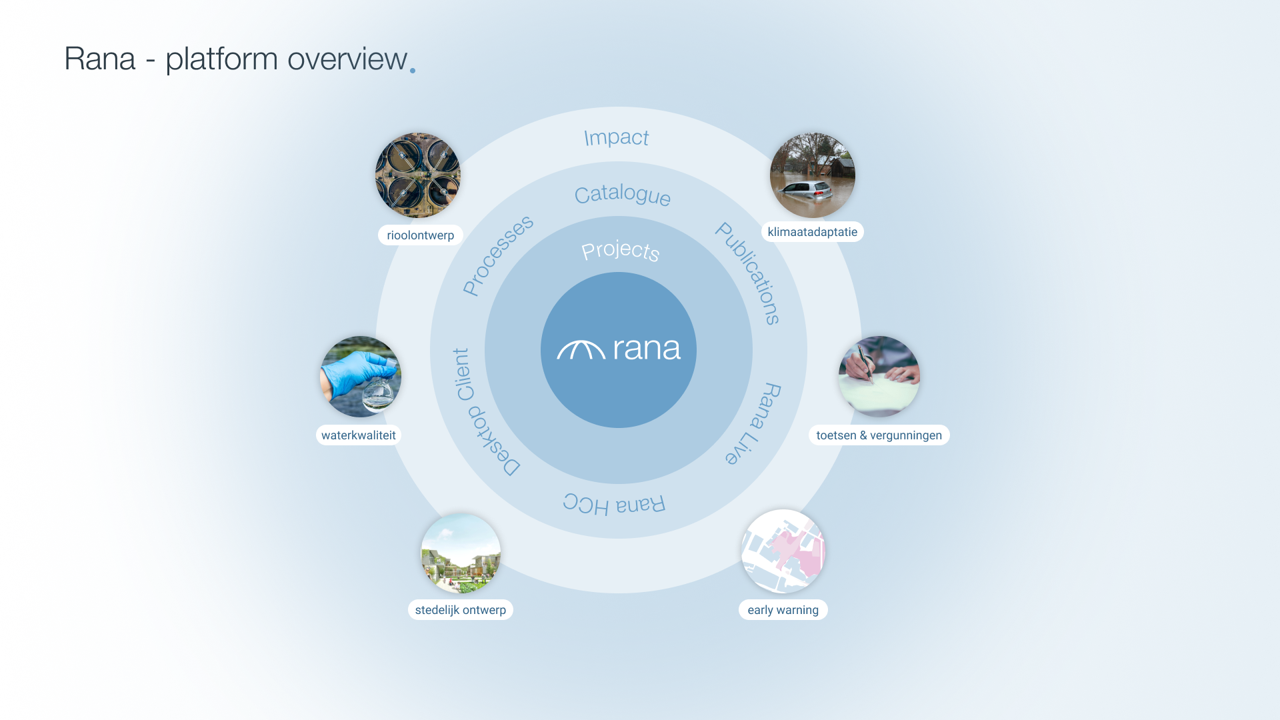
The other domains and their specific contribution are:
Online
*Processes*: Simple webforms that guide you through a wide range of GIS‑ and expert‑tool‑supported analyses, from determining flow patterns to launching integrated hydrodynamic models. All of this is possible without any GIS or advanced modelling experience.
Catalogue; Easy access to geodata that supports your analysis. Use only the data you need by clicking extract and selecting your study area. Missing data? Let us know via support@ranawaterintelligence.com, and we will consider adding the requested layer.
Publications; Every analysis has stakeholders. With Publications, you can combine datasets into a single publication and share it securely with your stakeholders. They can download the data in OGC‑compliant formats or view and comment on them in Rana’s online viewer. Thanks to this functionality, the viewer is widely used during integrated discussions and for validating (intermediate) results.
Rana Live: Rana Live is the environment for live interaction with your model. If you want to gain in‑depth insight into water behaviour in an area, Rana Live is the place to go. Equipped with the latest dynamic visualisation techniques, it provides intuitive feedback that even non‑experts can understand.
Rana HCC: The core engine that performs all computational work. While it’s not an environment humans interact with directly, understanding its underlying mathematical principles is essential for interpreting results. It forms the foundation of the integrated, fast, and highly accurate hydrodynamic calculation core.
All components are secured by an Authentication and Authorization system.
Off line
Rana Desktop Client Rana desktop client: Integrated into the open‑source QGIS environment, the Rana Desktop Client empowers trained experts in GIS and modelling to take full control of every aspect of water analysis. Create your own models, define detailed forcing, manage and style incoming data and results—full control and full ownership.
All user interfaces communicate with the Rana servers through the same Hydrodynamic calculation core API, a comprehensive application programming interface. You can use this API to interact with Rana from a Python script or integrate its capabilities into your own software products.